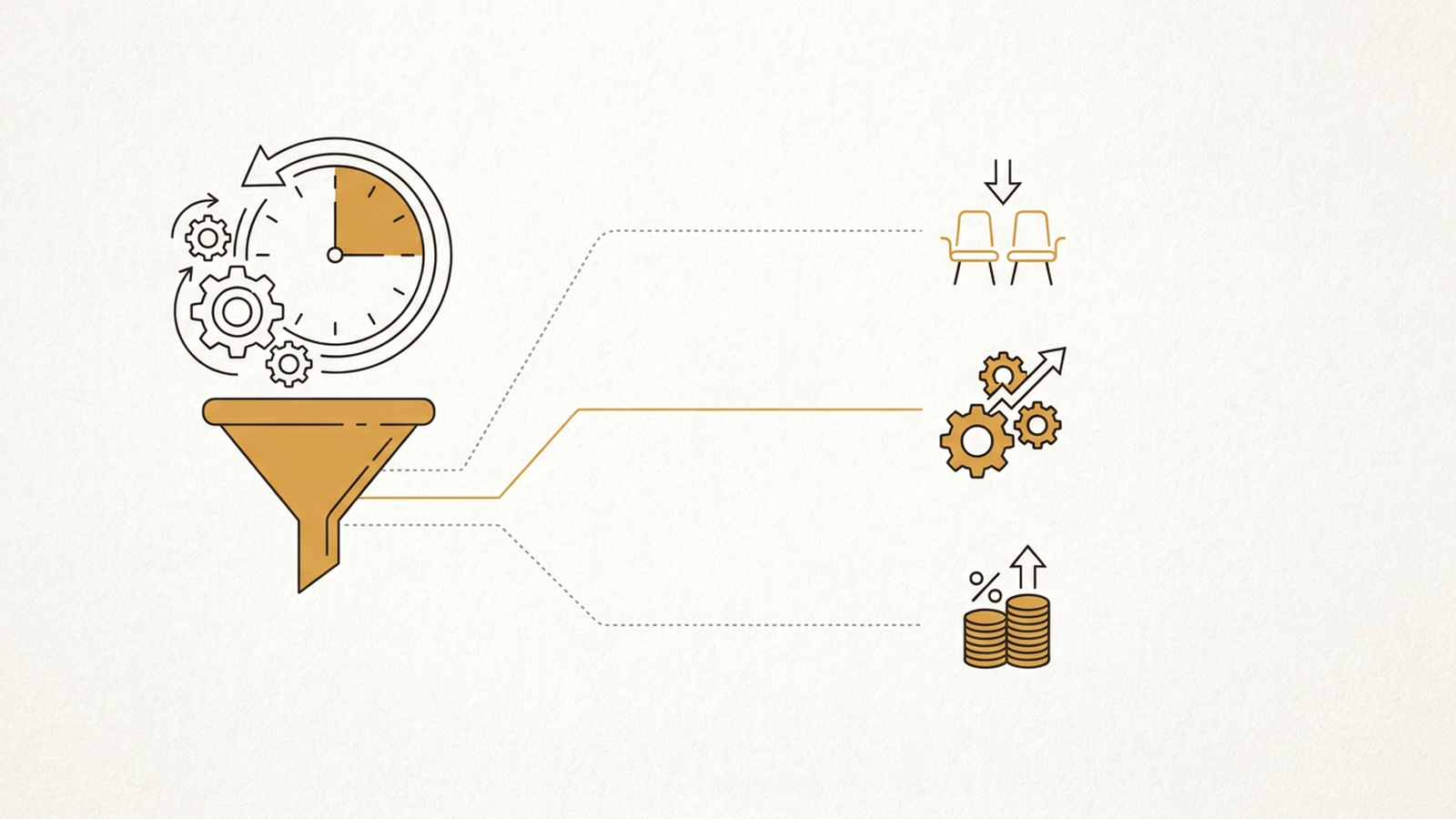
Every automation pitch ends with a number of hours saved per week. Almost none of them say what happens to those hours next. That missing step is where most automation budgets quietly evaporate, because saved time is a resource, not an outcome, and resources only pay off when something specific absorbs them.
The three conversions, and why they are mutually exclusive
Headcount conversion means a role shrinks, a hire does not happen, or a contractor gets cut. This is the cleanest conversion to measure because it shows up directly in payroll, but it is also the one most teams quietly avoid committing to, because saying it out loud in a project brief makes people nervous, so the target gets left vague instead.
Throughput conversion means the same number of people now produce more output in the same hours. This is the conversion most automation actually delivers, because the freed time gets absorbed into more tickets closed, more content shipped, more leads processed, without anyone deciding to grow the team. It only counts as a financial win if the extra output is sold, invoiced, or otherwise converted into revenue. If nobody was waiting on that extra output, throughput conversion produces nothing but busier employees.
Margin conversion means the work still gets done, at the same volume, for less cost — usually because a paid tool or a cheaper process replaces expensive human hours on a task with a fixed, sellable price. This is the conversion most consulting engagements are actually chasing, because it is the only one that reliably survives being audited by a finance person a year later.
You cannot get all three from one automation project. A workflow that frees up a support agent’s time either lets you not hire the next agent (headcount), lets the existing agent handle more tickets (throughput), or lets you deliver the same tickets more cheaply (margin). Pick one before the build starts. Trying to claim credit for all three at once is how automation projects end up defended with a slide full of hours saved and nothing that a CFO recognizes as a result.
Why this step gets skipped
Nobody wants to commit to a headcount number before the tool works, and throughput targets require someone downstream to actually absorb more volume, which depends on demand nobody controls. Margin targets require a real unit cost comparison, which means someone has to know what an hour of the replaced work actually costs today — loaded, not just the wage. Most teams do not have that number sitting anywhere, so they report saved hours instead, because saved hours are the only figure the automation itself can produce without anyone else’s cooperation.
This is not a criticism of measuring hours. It is a criticism of stopping there. Hours saved is an input metric. It belongs in an engineering retro, not in a business case, because a business case needs an output metric, and there are exactly three candidates.
What a workable business case looks like
State the conversion type on page one, before any hours-saved figure appears. “This automation is a headcount play: we expect to avoid one hire in Q2” is a falsifiable claim you can check in four months. “This will save the team ten hours a week” is not falsifiable in any way that matters financially, because ten hours can turn into nothing, a slightly less stressed team, or an actual dollar figure, and you will not know which until you specify the conversion in advance.
If you are building this internally, write the conversion target into the same document that describes the workflows you are automating, not into a separate ROI slide added after the fact. If you are commissioning it from outside, ask whoever is proposing the services which of the three conversions they are targeting, and hold them to that specific number rather than to hours saved. A consultant who cannot answer that question in one sentence has not thought past the build.
The uncomfortable case: none of the three
Sometimes an automation genuinely produces none of the three conversions, and that is a legitimate outcome, not a failure to hide. The team is happier, the process is less error-prone, the work feels less tedious, and none of that shows up as headcount, throughput, or margin this year. That is fine as a quality-of-work investment. It is not fine to present it as a financial win, because it is not one, and finance teams that get burned by that substitution once stop trusting automation proposals for years afterward.
The honest move is to say which kind of project this is before anyone builds anything. Hours saved is the easy number. The conversion is the hard one, and it is the only one that turns a nice demo into a result someone can point to a year later.